Dear Friends of KCRep,
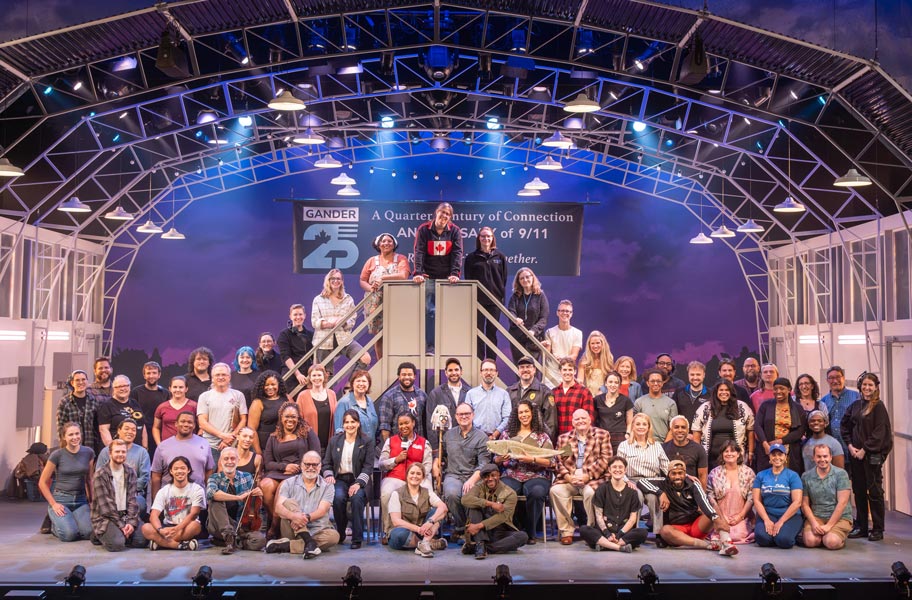
Twenty-five years after the attacks of September 11, 2001, the images of destruction remain fixed in our collective memory. But alongside that devastation, another story was unfolding — one of extraordinary generosity, courage, humor, and human connection.
When the United States closed its airspace, 38 planes carrying nearly 7,000 passengers were diverted to the small town of Gander, Newfoundland. In an instant, the population nearly doubled. The people of Gander and the surrounding communities opened their schools, churches, kitchens, closets, and homes to thousands of strangers. They offered food, clothing, shelter, medicine, and care. Again and again, they simply asked: “What do you need, and how can we help?”
Come From Away tells that remarkable story. But it is not really a play about a place in the past. It is a play about the choices we make when the world suddenly changes around us. Do we retreat into fear and protect only what is ours? Or do we move toward one another, trusting that our shared humanity is stronger than the forces that divide us?
From the beginning, I have thought about this production not only as a performance, but as an opportunity to practice community. Theatre is one of the few places where hundreds of strangers still gather in the same room, breathe the same air, listen to the same story, and experience something together. For a few hours, we become a temporary community —artists and audiences meeting one another in real time.
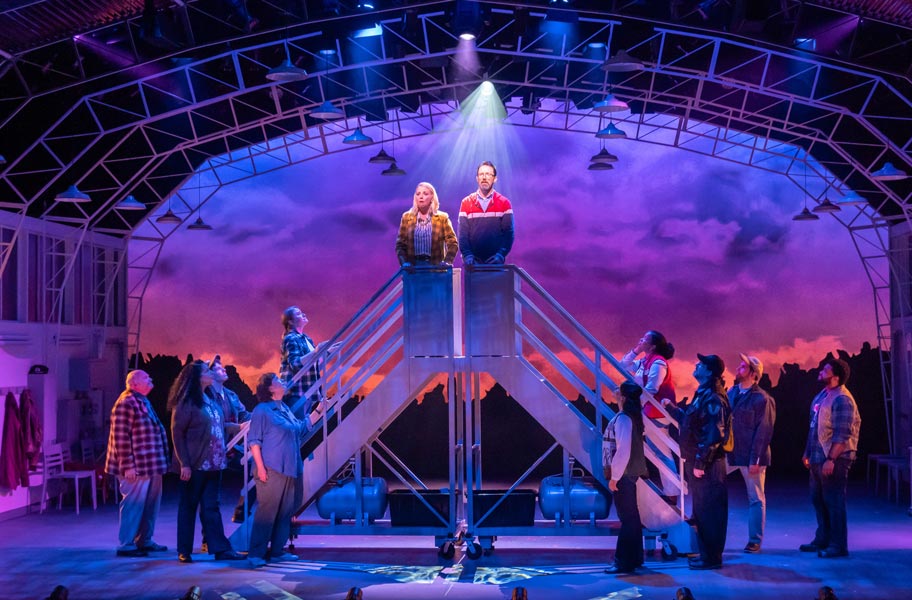
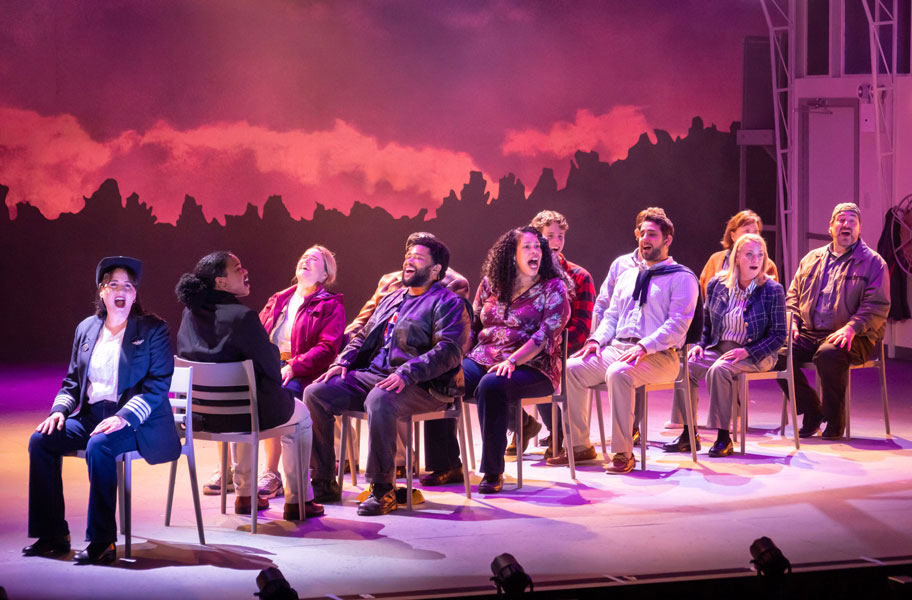
Our production invites you into a shared space inspired by an airport hangar — a place of arrival and departure, waiting, and uncertainty. The actors, musicians, and audience occupy that world together. The band is woven into the life of the room, and the storytelling asks us to use our collective imagination to transform a handful of chairs, a piece of music, or a simple gesture into an airplane, a bus, a bar, or an entire town.
At the heart of this story are ordinary people doing extraordinary things — not because they believe themselves to be heroes, but because someone standing in front of them needs help.
Thank you for joining us. Tonight, we invite you not only to witness this community, but to become part of it,
Stuart Carden
Q&A with Jenny Green
Interview by JANA LILES, Director of Marketing & Communications
Q: How do you approach designing costumes for a production? Where do you start? What is your process?
A: For me, the process starts with reading the script and seeing if any themes stand out. I’m also looking at time period, number of characters, and timeline of the show. I’ll then look for some inspiration in art and photos to take to the first meeting with the director to see what their vision looks like and we see how we would like to move forward. For Come From Away, I spent quite a bit of time looking up the real people in photos and videos so I could get a sense of how they are portrayed in the characters on stage. This show has no stops, and the flow of storytelling is a constant transition from character to character. With this in mind, I then spent time and thinking through how I can support the storytelling in a clear, but simplified, way.
Q: Costume design touches nearly every department. How closely did you collaborate with the director, scenic designer, lighting designer, and actors throughout the process?
A: I was in several meetings with the entire Design Team and Director. We all wanted to make sure the show could flow easily through the transitions. The Scenic Designer helped with making sure we had places built into the set to stash costumes and props. She also designed pass-throughs on the walls so there can be seamless hand-offs to the crew backstage. The Lighting Designer guided my color choices for costumes by providing the vision for the color and temperature of the stage. The Sound Designer and I talked through logistics of mic placement because hats, wigs, and anything going over an actor’s head can all affect the placement. As casting comes in, I touch base with the actors about measurements and asking them questions that can help me figure out the best fit and comfort for their clothing.
Q: This musical is based on real people and true events. How do you balance historical authenticity with the practical needs of live theater?
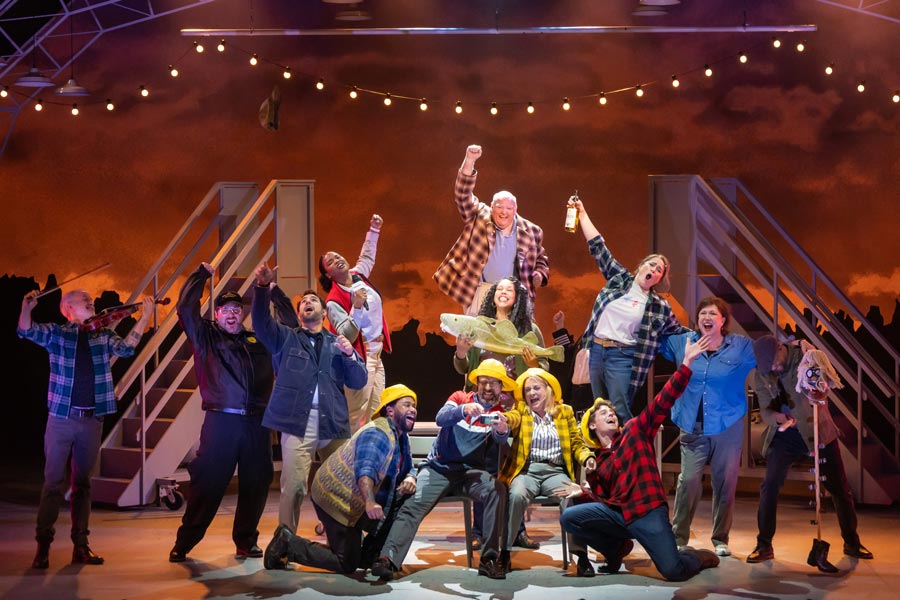
A: I grew up in a very small town here in Missouri and the familiarity and warmth the citizens of Gander and surrounding areas showed the visitors is something I could really connect with from my own upbringing. I could see the folks in my head and looked at what clothing we could provide for easy on and off that represent the many characters, while still being true and authentic to the setting of the show. We spent time distressing clothing to look lived in and real, not fresh off the store rack. For the simplicity needed for changes, I focused on hats, vests, and jackets; things that go on easily but are in the style and feel of a small town.
Q: This is an ensemble-driven show. How do costumes help support that sense of shared storytelling rather than drawing attention to individual pieces?
A: For me, it’s about simplicity and trust. You trust your actors to fill in the gaps with their work, and you trust your audience to use their willing suspension of disbelief that even a simple jacket change can tell which character is now in the scene.
Q: In addition to designing this production, you’re KCRep’s Director of Costumes and oversee the costume shop. How does wearing both hats influence your creative process?
A: Being the Director of Costumes and the Designer can be a real help to my process.
I usually start out with my bigger ideas and “dreams”. Then I take into consideration our staffing, schedule with other shows, budget, and what resources I know that we have in stock or in Kansas City. From there, I can pare things down to what is the most feasible as well as practical in the storytelling while keeping the overall vision of the show.
Q: Audiences often remember the performances more than the costumes — and that’s usually a sign the costumes are doing their job. What do you hope audiences feel, even if they don’t consciously notice the costume design?
A: I hope they look at an actor and right away they know something about the character before they’ve even said a word. They can subconsciously know social status, occupation, age, etc. They aren’t distracted by the costume, and it enhances the experience whether they realize it or not. Though the occasional, audible “wow” for big costumes and seamless quick changes are always fun to hear!